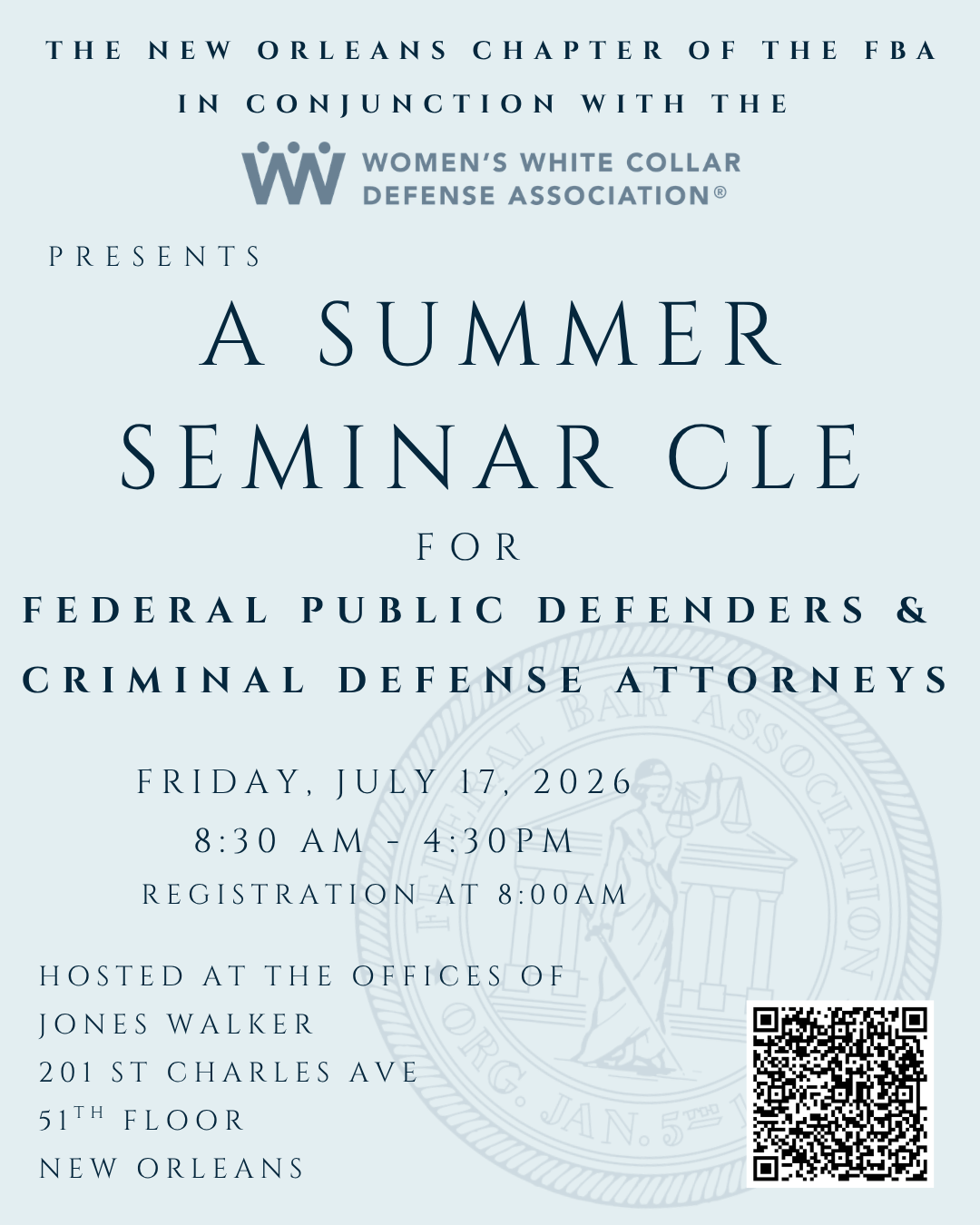
Summer Seminar CLE
Join the New Orleans Chapter of the Federal Bar Association on Friday, July 17, 2026 for a day of continuing legal education on recent developments in federal criminal law.
Hosted at the Offices of Jones Walker, 201 St. Charles Avenue, 51st Floor, New Orleans
This event is co-sponsored by the Women's White Collar Defense Association.
Speakers will explore recent developments in the law with an eye on defending clients in federal criminal cases. This 7 hour CLE including 1 hour of Professionalism and 1 hour of Ethics is free for Government Attorneys, Federal Public Defenders, CJA Panel Attorneys, and FBA members. WWCDA members are offered a reduced price ticket. Nonmembers are welcome for a small fee.
Please allow sufficient time for parking. Lunch and refreshments provided.
8:00 to 8:30am— Registration
Check in at the reception desk on the 51st floor.
8:30 - 9:30am— What's New in the 2026 Sentencing Guidelines presented by Jessica Collins (USSC)
Ms. Collins will discuss recent cases related to federal sentencing as well as focusing on Guideline Amendments and related topics.
9:30 - 10:30am— The BOP: A Deeper Dive presented by Jack Donson, Executive Director of the Federal Prison Education & Reform Alliance – PERA and Paul Gibson, Chief Operating Officer of PERA
This session will include practice tips regarding mitigation and proactively managing the presentence investigation for better outcomes. It will also provide an insider's perspective on classification, designation, BOP programs and the First Step Act. Jack and Paul have worked in various prison environments from pre-trial operations to penitentiaries. All BOP issues can be addressed and they will be available for Q & A during the breaks throughout the day.
10:30 - 10:45am— Break
10:45 - 11:45am— Ethics Issues in IAC Claims presented by Professor Tigran W. Eldred, Senior Lecturer at Boston University School of Law
This session will consider ethical issues that arise in claims for ineffective assistance of counsel. These include duties owed by the lawyer who was allegedly ineffective (“former counsel”), such as the duty to cooperate with the former client’s new lawyer (“successor counsel”); the duty to provide the former client’s file to successor counsel; the duty to convey information not contained in the former client’s file to successor counsel; and the scope of the duty of confidentiality owed to the former client. Practical ways for successor counsel to navigate the relationship with former counsel will also be addressed.
11:45 - 12:15pm— Lunch provided by the Federal Bar Association
12:15 - 1:15pm — What’s new in the Fifth Circuit? Firearms, search warrants, and more presented by Steven Spires of the Federal Public Defender’s Office
This session will cover recent developments in Fifth Circuit law concerning firearms offenses and constitutional challenges to firearm possession prosecutions. Mr. Spires will also give a brief refresher on search and seizure litigation, review recent victories, and address the Supreme Court's Chatrie decision concerning geofence warrants.
1:15 - 2:15pm— Professionalism: A (Retired) Judge’s View on What Works and What Doesn’t presented by retired federal Judge Stanwood Duval
This professionalism hour will feature retired federal Judge Stanwood Duval sharing candid insights and opinions on effective advocacy in federal criminal cases. Drawing from his years on the federal bench, Judge Duval will discuss what works and what doesn’t in everything from trial and motions practice to sentencing advocacy. He will also discuss thoughts on tactics for successful plea negotiations based on his years as a mediator and arbitrator after he left the federal bench. The discussion will be moderated by Sara Johnson, but questions from the audience will be encouraged.
2:15 - 2:30pm— Break
2:30 - 3:30pm— Thinking — We mean Really Thinking — About Plea Agreements and Factual Bases presented by Attorneys Stephen Haedicke and James Washington
It’s probably the case that most federal criminal practitioners haven’t stopped and really thought about plea agreements and factual bases in some time. We often argue about various aspects of the documents presented to us by the government, but there is typically a lot of unspoken and unexamined agreement about the typical forms. This presentation—which will hopefully evolve into a group discussion and brainstorming session—will try to identify and expose those examined assumptions about the plea agreement process. Going back to first principles (e.g. Rule 11), we will discuss what the law actually requires for plea agreements and factual bases, and contrast that with the usual practices in the federal courts of Louisiana. We will provide some thoughts about pleading with and without agreements, and brainstorm how we might push back on the government’s position on the terms of any agreements and the drafting of the factual basis.
3:30 - 4:30pm — FBI Investigations, Records and Files for Defense Attorneys presented by Mike Zummer with Empower Oversight
This one-hour CLE will focus on the FBI investigative process, specifically how it organizes its files so that attorneys, particularly criminal defense attorneys, will know how to ensure the FBI has turned over all required evidence in discovery. The CLE will cover the following specific topics: 1. What basis the FBI has to open certain investigations and what investigative authorities it has for different types of investigations. 2. How the FBI organizes its investigative files and the different types of documents maintained in them. 3. The FBI’s computerized central records system and other electronic records it maintains. 4. The FBI’s methods to search for records in its system and how different entities within the FBI will respond to criminal discovery, civil discovery, and Freedom of Information Act requests. 5. The FBI’s ability to restrict and prohibit access to records in its computerized system. 6. Common problems in criminal discovery and how to address them. 7. Other means of obtaining FBI records and the challenges with them. 8. The FBI’s use of classified information and how that may arise in criminal cases.